Robotic Process Automation (RPA) helped organizations eliminate repetitive, rule-based work. Artificial Intelligence (AI) helps them make smarter, context-aware decisions. When you combine RPA with AI, you get intelligent automation: workflows that not only do tasks faster but also understand, decide, and improve over time. Today, businesses are leveraging virtual agents AI and contact center AI solutions to enhance customer experiences, streamline operations, and drive efficiency across their digital processes.
Modern enterprises are increasingly using cloud-based platforms with built-in AI capabilities to store, manage, and analyze large volumes of data securely and efficiently. Advances in everyday computing systems powered by artificial intelligence are helping teams make smarter choices and automate routine technical tasks. On the marketing side, companies are adopting AI-driven strategies to create personalized campaigns and improve customer engagement. Meanwhile, intelligent tools for managing online promotions and tracking audience behavior are transforming the way brands connect with customers in the digital space. Even in finance, AI-enabled solutions for analyzing financial trends, predicting risks, and automating reporting tasks are helping organizations make faster, data-backed decisions. Together, these innovations create a smarter, more connected ecosystem where operations, marketing, and finance work seamlessly with technology.
Top 10 Contact Center Solutions Leveraging RPA with AI to Transform Customer Experience
When it comes to enhancing customer service while automating routine workflows, RPA with AI is at the forefront of innovation. Companies are using intelligent automation to improve efficiency, reduce costs, and deliver personalized support at scale. Here’s a look at the leading contact center solutions that combine automation with AI capabilities:
1. Bright Pattern – Intelligent AI Contact Center Solutions
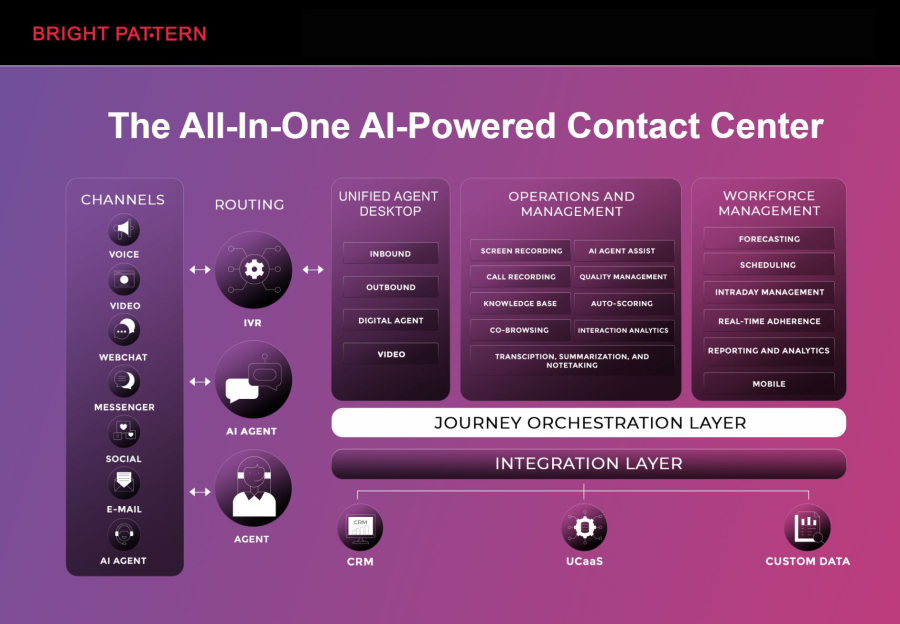
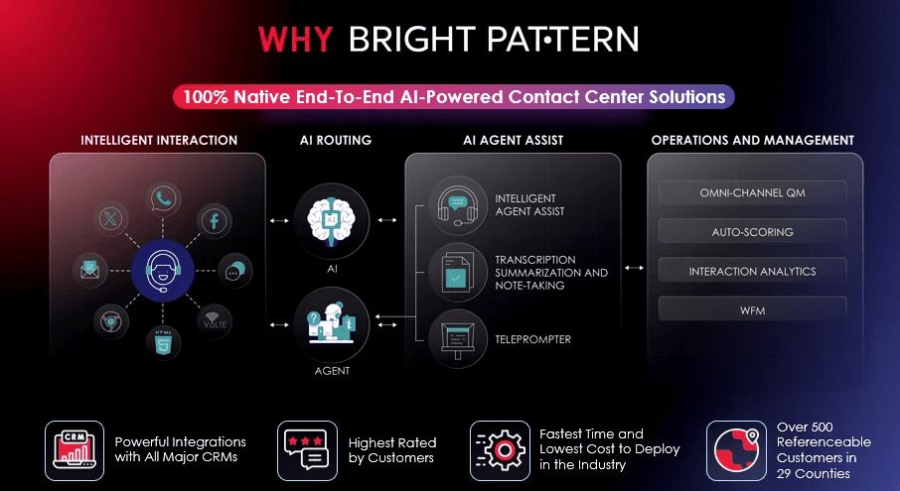
Bright Pattern stands out as a market leader in combining RPA with AI to create seamless customer experiences. Its platform integrates virtual agents AI and advanced automation to deliver intelligent, multi-channel customer support.
Key features include:
- AI-powered chatbots and virtual assistants that can understand and respond to complex customer queries.
- Smart workflow automation to handle repetitive tasks, freeing agents for higher-value work.
- Omnichannel support across voice, chat, email, SMS, and social media.
- Real-time analytics and reporting to track performance, identify bottlenecks, and improve processes.
Bright Pattern’s platform allows businesses to unify AI-driven automation with human agents, enabling a dynamic contact center environment where AI handles routine inquiries while agents focus on complex customer needs.
2. Five9
Five9 offers cloud-based contact center software with AI capabilities, including predictive dialing, intelligent routing, and virtual agent support to streamline customer interactions.
3. Genesys
Genesys provides omnichannel customer experience solutions that combine AI-driven automation, chatbots, and workflow optimization to improve agent productivity.
4. Talkdesk
Talkdesk uses AI to enhance call routing, sentiment analysis, and automated agent assistance, making customer interactions faster and more efficient.
5. NICE inContact
NICE inContact CXone leverages AI for workforce optimization, smart routing, and predictive analytics to improve contact center operations.
6. 8x8
8x8 integrates AI-driven insights and automation for contact centers, including virtual agents, speech analytics, and real-time customer engagement tools.
7. RingCentral
RingCentral Contact Center combines cloud communication with AI-powered analytics and virtual assistant capabilities to streamline customer support.
8. Avaya
Avaya provides intelligent contact center solutions with AI-powered automation, predictive routing, and analytics to enhance customer experience.
9. Cisco Contact Center
Cisco Contact Center uses AI-driven virtual assistants, analytics, and automation tools to optimize customer interactions and agent efficiency.
10. Zendesk
Zendesk leverages AI and automation to support omnichannel customer engagement, including virtual agents, workflow automation, and advanced reporting.
What Is RPA with AI (Intelligent Automation)?
RPAuses software "bots" to mimic how a human interacts with applications: clicking buttons, entering data, copying information between systems, and triggering routine steps. These bots follow explicit rules and are ideal for highly structured tasks.
AIadds capabilities such as understanding text, recognizing patterns, and making predictions. Key AI techniques include:
- Machine learning (ML)for pattern recognition and predictions.
- Natural language processing (NLP)for understanding and generating human language.
- Computer visionfor interpreting documents and images.
When you integrate AI into RPA, you getintelligent process automationthat can:
- Handle unstructured data, such as emails, PDFs, and images.
- Make risk-based or priority-based decisions.
- Continuously learn and improve through feedback.
Why Combine RPA with AI Instead of Using Them Separately?
RPA and AI each solve different parts of the automation puzzle. Used together, they close the gap between simple, rules-based tasks and complex, judgment-intensive work.
RPA Alone: Great at Repetition, Limited at Judgment
- Excels at high-volume, structured, rule-based activities.
- Works best when inputs are clean and standardized.
- Struggles when data is ambiguous, incomplete, or unstructured.
AI Alone: Great at Intelligence, Needs a Delivery Mechanism
- Can analyze messy data and provide recommendations or classifications.
- Still needs a way to act on its insights inside your business systems.
- By itself, it does not log into systems, move data, or complete multi-step workflows.
RPA with AI: End-to-End Intelligent Automation
By combining the two, you create a powerful engine that canthink and do:
- AI interprets inputs and makes decisions.
- RPA executes tasks across applications based on those decisions.
The result is a digital workforce that can manage more complex processes with minimal human intervention.
Core Components of RPA with AI
While every organization designs its own architecture, most intelligent automation solutions use a similar building-block pattern.
1. RPA Bots
Software bots complete structured tasks such as:
- Logging into applications and websites.
- Copying and pasting data between systems.
- Triggering transactions and updating records.
- Generating reports and sending notifications.
2. AI Services
AI components extend what bots can handle. Common examples include:
- Document understandingto extract data from invoices, contracts, and forms.
- Language understandingto interpret emails, chat messages, and support tickets.
- Prediction modelsto estimate risk, likelihood of churn, or payment delays.
- Gen AI and large language modelsto summarize content or draft responses.
3. Orchestration and Workflow
An orchestration layer coordinates the flow between AI services, RPA bots, and human workers. It typically manages:
- Which bot handles which tasks, and when.
- When to trigger an AI model to analyze inputs.
- When to escalate to a human for review or approval.
- Logging, monitoring, and exception handling.
4. Human-in-the-Loop Interaction
Even the most advanced setup benefits from human judgment for edge cases and continuous improvement. Humans may:
- Review and validate AI predictions in high-risk situations.
- Handle exceptions that fall outside defined rules.
- Provide feedback that improves models and bot logic.
Key Business Benefits of RPA with AI
Organizations adopt intelligent automation to transform how work gets done, not just to cut costs. Here are the most important benefits.
1. Higher Productivity and Throughput
- Bots operate 24/7 without breaks, increasing overall capacity.
- AI removes manual pre-work such as reading emails or sorting documents.
- Processes with complex decision points can still be handled end-to-end.
This means teams can handle more volume without adding headcount, or reassign people to higher-value work instead of repetitive tasks.
2. Improved Accuracy and Compliance
- RPA reduces manual entry errors in fields, codes, and reference data.
- AI can flag anomalies, missing information, or out-of-policy actions.
- Every action taken by a bot can be logged for audit trails.
For regulated industries such as financial services, healthcare, and insurance, this combination supports stronger compliance and easier reporting.
3. Faster Cycle Times and Better Customer Experience
- Requests, claims, and applications are processed more quickly.
- Customers receive real-time updates and faster resolutions.
- Service teams can focus on empathy and complex cases instead of data entry.
Shorter turnaround times translate into higher customer satisfaction and stronger loyalty.
4. Greater Process Visibility and Control
- Bot and AI activity is monitored centrally, making performance visible.
- Dashboards reveal bottlenecks, rework, and exception trends.
- Data from automation feeds continuous improvement initiatives.
With better insights, leaders can tune processes to balance cost, speed, and quality.
5. Scalable, Flexible Operations
- Automation can scale up during peak seasons and scale back after.
- New rules, models, or workflows can be updated centrally.
- Organizations can adapt quickly to new regulations or product lines.
This agility helps businesses respond to market shifts without large hiring swings.
High-Value Use Cases for RPA with AI
RPA with AI can support almost any function that relies on digital data and repeatable steps. These are some of the most impactful areas.
1. Finance and Accounting
- Invoice processing: AI reads invoices and extracts key fields; RPA matches them to purchase orders and posts them to the finance system.
- Expense management: Bots validate expense claims while AI checks for policy violations or unusual patterns.
- Account reconciliations: RPA compares records across systems; AI flags exceptions requiring human attention.
2. Customer Service and Support
- Intelligent ticket routing: NLP categorizes emails and chat messages, and RPA routes them to the right queue or knowledge base.
- Response assistance: AI suggests responses; bots gather relevant account data and update systems after the interaction.
- Self-service workflows: AI-powered chat interfaces trigger RPA bots to execute back-office tasks, such as resetting passwords or updating details.
3. Banking, Insurance, and Financial Services
- Loan and policy applications: AI reads applications; bots verify identity, pull credit data, and update internal systems.
- Claims processing: AI evaluates documentation and detects possible fraud signals; RPA executes payments and updates records.
- Regulatory reporting: Bots gather data from multiple systems; AI checks for anomalies or missing detail before reports are finalized.
4. Healthcare and Life Sciences
- Patient onboarding: AI extracts data from intake forms; RPA populates electronic records and schedules appointments.
- Billing and coding support: AI helps propose codes based on documentation; bots submit claims and reconcile payments.
- Data quality for analytics: RPA cleans and standardizes data while AI identifies inconsistencies and gaps.
5. Supply Chain and Operations
- Order processing: RPA retrieves orders from various channels; AI predicts delivery risks and suggests prioritization.
- Inventory optimization: AI forecasts demand; bots adjust purchase orders and stock levels accordingly.
- Vendor management: AI evaluates vendor performance metrics; RPA updates scorecards and sends routine communication.
6. Human Resources
- Recruitment support: AI screens resumes and ranks candidates; bots schedule interviews and send notifications.
- Employee onboarding: RPA creates user accounts, assigns training, and initiates payroll; AI-powered assistants answer new-hire questions.
- HR service desk: NLP interprets employee requests, while bots perform actions such as status checks and record updates.
How to Get Started with RPA and AI Together
Successful intelligent automation programs start small, prove value quickly, and scale with a clear roadmap.
1. Identify the Right Processes
Prioritize processes that meet these criteria:
- High volume and frequency, so automation delivers meaningful savings.
- Clear business rules, even if some steps need AI to interpret data.
- Digital inputs, or inputs that can realistically be digitized.
- Significant impact on customer experience or compliance.
Examples include invoice handling, service ticket triage, and common back-office requests.
2. Map the End-to-End Workflow
Work with process owners and frontline staff to:
- Document each step, decision point, and exception.
- Identify where unstructured data appears, such as emails or PDFs.
- Clarify which decisions are rules-based versus judgment-based.
This gives you a blueprint for where RPA takes over and where AI adds value.
3. Choose Automation and AI Capabilities
Most organizations combine:
- An RPA platform to manage and orchestrate bots.
- Built-in or connected AI services for document understanding, NLP, and machine learning.
- Data pipelines for training and improving models over time.
Some platforms bundle RPA and AI together; others integrate specialized AI components. The best choice depends on your existing systems and skills.
4. Start with a Pilot, Then Scale
Launch with a focused pilot to demonstrate quick wins, such as:
- Reducing processing time for a specific workflow.
- Lowering error rates in data entry or document handling.
- Freeing a measurable number of hours for a target team.
Once you validate value and refine governance, expand to additional processes and departments.
5. Build the Right Team and Governance
High-performing intelligent automation programs typically involve:
- Business process ownersto define goals, rules, and success measures.
- Automation engineersto design, build, and maintain RPA workflows.
- Data and AI specialiststo select, train, and monitor models.
- Change management leadsto support adoption and communication.
Governance ensures that automation is secure, transparent, and aligned with corporate policies and regulations.
Best Practices for Maximizing Value
To get the strongest results from RPA with AI, consider these practical guidelines.
1. Design for Humans and Bots Working Together
- Let bots handle the repetitive work, while people focus on exceptions and relationship-driven tasks.
- Provide clear, simple interfaces for employees to hand work to bots and receive outputs.
- Make it easy to override or adjust AI decisions when needed.
2. Prioritize Data Quality
- Clean and standardize data sources feeding your AI models.
- Define consistent formats for documents and forms where possible.
- Monitor model performance and retrain as your data and processes change.
3. Build Trust Through Transparency
- Document what each bot does and which AI models are used.
- Explain how decisions are made, especially when they affect customers or employees.
- Give users visibility into automation status and clear escalation paths.
4. Measure What Matters
Track metrics that align with your business objectives, such as:
- Cycle time reduction for key processes.
- Accuracy and error-rate improvements.
- Employee hours saved and redeployed to strategic work.
- Customer satisfaction scores and response times.
Use these insights to refine your automation backlog and invest where value is highest.
5. Start Responsible and Stay Responsible
- Assess and manage risks such as bias, privacy, and security.
- Ensure compliance with relevant regulations in your industry and regions.
- Establish clear ownership for AI model governance and bot behavior.
The Future of RPA with AI
Intelligent automation is evolving quickly. Several trends are shaping its future impact.
1. More Natural Interactions
Advances in conversational AI mean employees and customers will increasingly interact with automation through natural language. Instead of clicking through complex interfaces, they will simply ask for what they need, and bots will coordinate the underlying work.
2. Self-Improving Processes
Automation will not just execute predefined workflows; it will help redesign them. By analyzing historical performance, AI will suggest process changes, rule updates, and new automation opportunities, making operations progressively leaner and smarter.
3. Wider Democratization of Automation
Low-code and no-code tools, combined with embedded AI, will allow more business users to design and deploy automations under proper governance. This broad participation can accelerate innovation while keeping IT in control of standards and security.
4. Deeper Integration Across the Enterprise
RPA with AI is increasingly woven into core platforms such as ERP, CRM, and HR systems. Instead of being a standalone initiative, intelligent automation becomes part of the fabric of how work gets done across the organization.
Conclusion: Turning RPA and AI into a Strategic Advantage
RPA with AI is more than a technology trend. It is a practical way to redesign work so that people and digital workers complement each other.
By thoughtfully combining RPA and AI, your organization can:
- Free teams from repetitive, low-value tasks.
- Improve accuracy, compliance, and control.
- Deliver faster, more consistent customer experiences.
- Scale operations smoothly as demand fluctuates.
With a clear strategy, strong governance, and a focus on human-centered design, intelligent automation can become a powerful engine for growth, innovation, and long-term competitive advantage.
